


Why Your 4th Grader Still Can’t Multiply (And How to Fix It)
If your 4th grader is still struggling with multiplication, you’re not alone. This is one of the most common issues we see—and it’s also one of the most important to address.
Multiplication is a foundational skill. When it’s not solid, everything that builds on it becomes harder—division, fractions, multi-step problems, and even algebra later on. So while it might feel like “just one skill,” it has a ripple effect across all of math.
What often confuses parents is that their child can multiply—they just can’t do it efficiently. They may be using strategies like repeated addition, skip counting, or drawing models. Those strategies are helpful in the early stages, but by 4th grade, they are too slow to keep up with the demands of the work. That’s where frustration starts to build.
Where to Find Online Tutoring for Advanced Math Support
As math becomes more complex, gaps become more noticeable.
Students who struggle with multiplication often:
rely on counting or repeated addition
take a long time to solve problems
lose track in multi-step work
make errors due to cognitive overload
Online tutoring helps by targeting the exact skill that’s slowing everything down. Instead of continuing to layer more complex math on top of a weak foundation,
we go back, build fluency, and then reconnect
it to grade-level work.
When multiplication becomes automatic, students free up mental space to actually think through problems instead of just trying to get through them.
What’s Actually Going Wrong
for students who still can't multiply?
Most students in this situation don’t fully know their multiplication facts.
They can figure them out—but they don’t know them.
That difference matters.
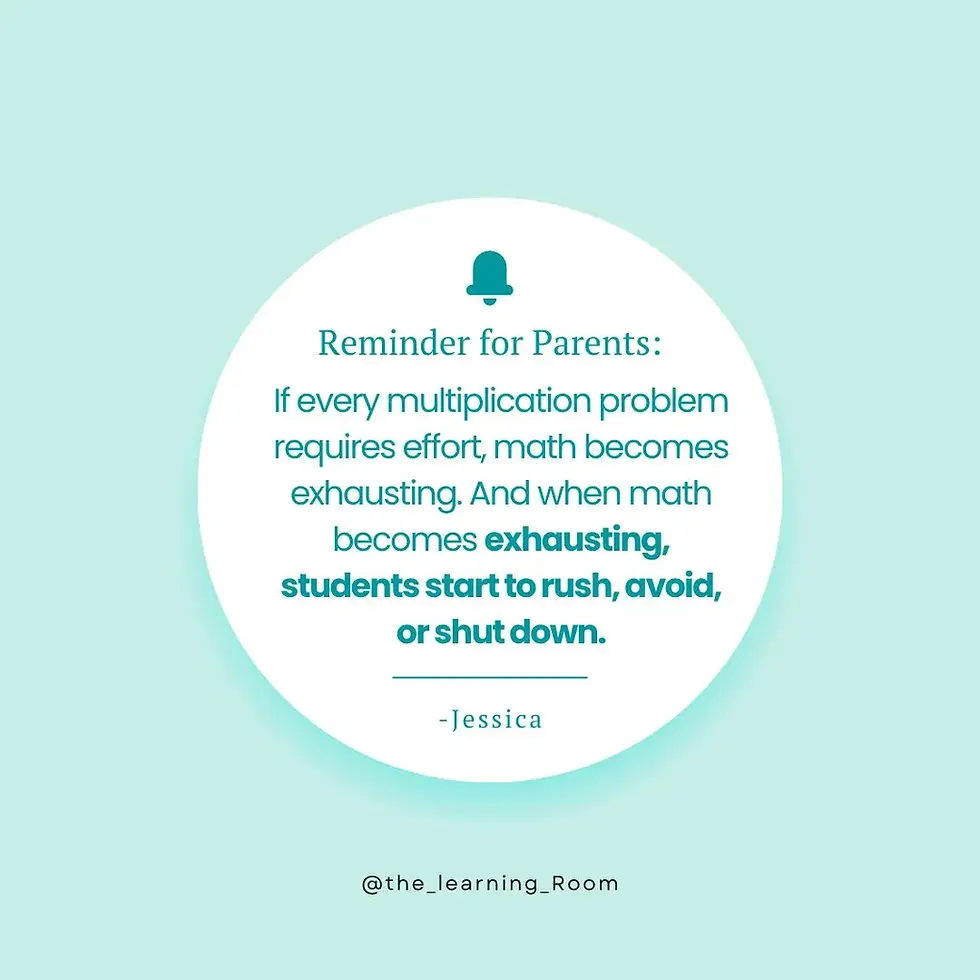
If every multiplication problem requires effort, math becomes exhausting. And when math becomes exhausting, students start to rush, avoid, or shut down.
This is also where we see students lose their place in problems. They’re doing math in the margins just to solve basic facts, which interrupts their thinking and leads to mistakes—even when they understand the concept.
How to Fix It (Action Steps)
Practice one fact family at a time
Keep practice short and consistent (daily is best)
Mix fact practice into real math problems
Focus on accuracy before speed
Reduce reliance on counting strategies
When working on multiplication, focus matters more than volume. Instead of jumping between all facts, choose one family (like 4s or 6s) and work on it repeatedly in different ways—flashcards, quick drills, and application problems. This repetition helps move facts into long-term memory.
Want more information on how we teach multiplication? Download our free guide here.
It’s also important to connect multiplication to actual math work. If your child is only practicing facts in isolation, it won’t transfer as easily. But when those same facts show up in word problems or multi-step problems, they begin to see how it all fits together. Over time, this builds both fluency and confidence.
Best Online Math Tutoring for Elementary Students
The most effective tutoring doesn’t just give more problems—it builds skill intentionally.
That means:
targeting the exact gap
providing repetition with purpose
connecting skills to real application
If your child is still struggling with multiplication in 4th grade, it’s not something to wait on. This is the point where intervention makes everything else easier.


Comments