


How Long Until Tutoring Works? What Results You Can Expect From Academic Coaching
Why The Learning Room Gets Faster, Clearer, and More Measurable Progress
One of the top questions parents ask is, “How long until we see results?”It’s completely understandable—academic help is an investment, your child’s confidence is fragile, and you want to know what to expect.
But here’s the reality most agencies avoid sharing: results vary depending on the child, the quality of instruction, consistency, cognitive load, and what’s happening outside sessions. And almost no one publishes their success rates because they fear being held to a standard.
At The Learning Room, we publish ours anyway. Here, parents deserve clarity.
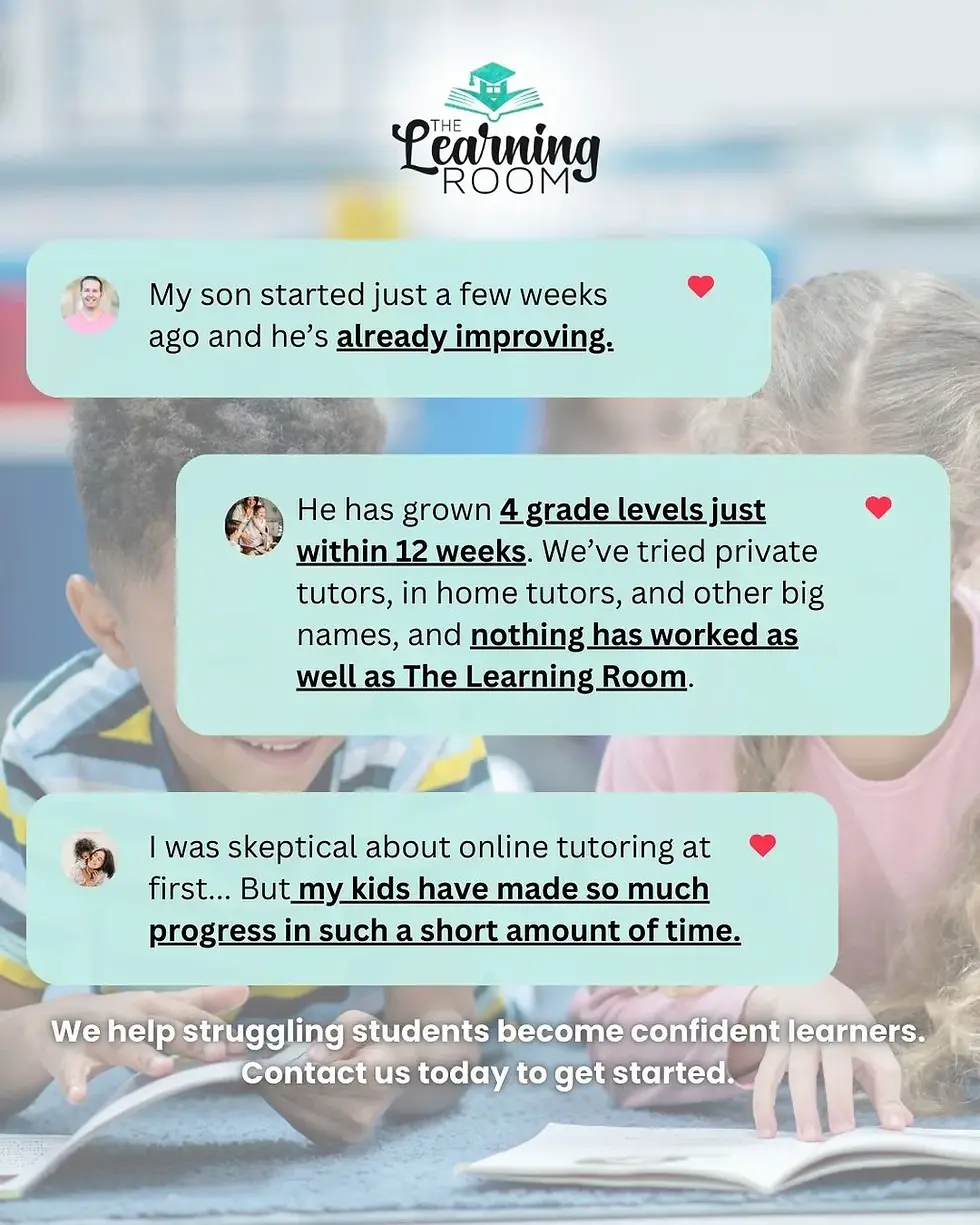
Why We Publish Our Success Rates (When Most Others Don’t)
Most tutoring companies talk about curriculum, worksheets, or their “approach.” Few talk about actual outcomes.
We do.
On average, our students make two years of academic growth in six months. This number is a true average—some grow faster, some slower, depending on needs and consistency.
The reason we can publish results is simple: Our model is built on actual teaching, not homework help. And when the instruction is high-quality, strategic, and customized, progress moves quickly.
Parents deserve to know exactly what kind of return they can expect.
What Families Should Ask Before Hiring Any Tutor
Before you hire someone to support your child, ask:
What results do your students typically see?
How do you measure progress?
What assessments do you use, and what do they show?
How do you decide what to teach each week?
Do you fill learning gaps or just help with homework?
If a provider can’t clearly answer these questions, that’s a red flag. Not all tutoring is designed to close gaps—and many parents don’t realize the difference until they’ve lost months of time.
Why The Learning Room Gets Faster Results Than Traditional Tutoring
Our approach produces faster, more sustainable progress because we focus on the root of the problem—not the symptoms.
We start with diagnostic assessments that identify exactly why a child is struggling. Then we create a custom plan that addresses those gaps directly.
Our academic coaches are certified teachers with deep expertise in reading instruction, math foundations, and child development. Nothing we do is pre-scripted. Every lesson is tailored to the learner sitting in front of us.
This allows us to move quickly, pivot instantly, and combine gap-filling instruction with support for classroom demands—all in one session.
That is why our results are different.
Progress Is NOT Linear — And That’s Normal

Learning doesn’t move in a straight line. Parents often expect steady weekly improvement, but real growth is more complex.
Some students make progress immediately because their challenge stems from a minor misunderstanding. Others take longer because their foundational gaps are wider or the missing skill is more complex.
The pattern we often see is a ramp-up phase in months 1–2, followed by a huge spike in months 3–6. This happens once enough foundational pieces are in place for everything else to “lock in.”
Both patterns are normal. Both lead to success.
Cognitive Load: The Hidden Factor That Can Speed Up or Slow Down Progress
Cognitive load refers to the mental and emotional bandwidth a child has for learning. If a child is tired, anxious, overstimulated, hungry, overwhelmed, or dysregulated, their brain is not ready to absorb or retain new information.
The brain simply cannot learn effectively while anxious.
Many of our students take off once they feel comfortable, connected, and confident with their academic coach. As trust builds and stress decreases, their cognitive load drops—and progress begins to accelerate.
Comfort often predicts speed. And confidence ALWAYS multiplies progress.
Consistency Is One of the Biggest Predictors of Fast Progress
Consistency matters far more than people realize. Every missed session is lost instructional time—and that time adds up.
This is why The Learning Room reschedules missed sessions instead of canceling them. Your child gets the time back, keeps the routine, and stays connected to the learning process.
Inconsistent attendance is one of the fastest ways to delay progress.
Consistent attendance is one of the fastest ways to accelerate it.
What Happens at Home Can Double (or Half) the Rate of Progress
Parents often ask how much support they are expected to provide outside sessions. The answer? Very little. But the right little bit makes a big difference.
Kids working on math facts progress twice as fast when they practice 8–10 minutes a day. Kids working on reading fluency improve dramatically with 10–15 minutes of reading between sessions. Students using the apps we assign make leaps instead of inches.
These touchpoints don’t need to be long—they just need to be consistent. Small habits create big outcomes.
Why Online Tutoring Works Better Than In-Person (Yes, Really)
When I started The Learning Room eight years ago, I tutored entirely in person. I believed in-person would always be better.
But once I moved online, something unexpected happened—students started progressing faster.
In-person environments are noisy, mobile, and distracting: siblings walking around, parents cooking nearby, TV noise, and kids constantly getting up for water or snacks. Even libraries have constant movement.
Online is the opposite.
Kids naturally sit in a quiet space, often wear noise-blocking headphones, and focus their attention on the screen. The setup itself promotes attention, even for students with ADHD.
From the teaching side, online is a game-changer. I have every resource, lesson, assessment, and tool at my fingertips—meaning I can pivot instantly when a child needs something new.
And because online sessions can happen from anywhere, families cancel far less. The more sessions we keep, the faster the growth.
Families who try in-person alternatives almost always come back, saying: “We made a mistake. We tried in-person for a few months with no results.”
So… How Long Until You See Results?
Most families see:
Weeks 1–3:Small wins, increased confidence, reduced frustration
Months 1–3:Clear improvement, skills stabilizing, classroom performance rising
Months 3–6:Major growth and foundational acceleration
With consistent attendance and a focused learning environment, results come quickly and build on themselves.
This is how we average two years of progress in six months.
Your child can improve—and often far faster than you’ve been led to believe.
Final Thoughts: Your Child’s Growth Is Absolutely Possible
Academic struggle is not permanent. Confidence can be rebuilt. Skills can be strengthened. Gaps can close. Kids can feel proud again.
You don’t need years of tutoring. You need the right approach.
If you’re ready for measurable growth, expert support, and a personalized plan built around your child’s needs, The Learning Room is here to help.


Comments